The NVWG annual potluck is coming up! Here are the details.
Tuesday 6/23, starting at 6pm
At Marie Porteus’ home (see Members page for address)
Parking is on the driveway or diagonally on the grass in front of and to the side of the house.
What to bring:
Dish to share (with ingredients listed)
Beverage for yourself
Place setting (plate, cup, silverware, napkin)
Lawn chair
2026 Challenge project – Weaving from around the world.
Dress for being outside (including bug spray!) If it’s rainy, we’ll be inside. If it’s hot, the ‘water park’ will be open.
Besides eating, show & tell of our challenge items and catching up with everyone, there will be a brief meeting to elect our new officers. The officer slate will be sent in a separate email.
If you want anything from the Guild Library to read over the summer, please contact Kathy librarian@nvwg.org by Monday 6/22. You can browse what’s available in the library on our website. https://nvwg.org/library/
Nashoba Valley Weavers' GuildPosted on by Penny Lacroix
Tuesday May 26, 2026, 7pm in person only, at the Congregational Church of Harvard, 5 Still River Rd
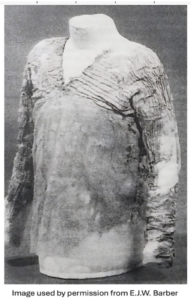
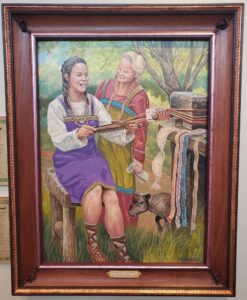
The Tabletweaver – Scotland 850CE by D. Sven Lindauer
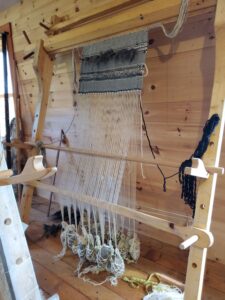
What does “Norwegian Weaving” mean? Is it a historical nomenclature? Is it a modern style? Is it a specific structure or structures? NVWG member Penny Lacroix will give a presentation on weaving in Norway. Scandinavia in general has a reputation for a particular style of weaving (perhaps perpetuated by IKEA?) Zooming in on Norway, we’ll take a look at some historical weaving as well as modern interpretations. Among the topics will be warp-weighted loom weaving, band weaving, krokbragd, “picture weaving”, rya, and other techniques. We’ll also look at motifs and colors that are associated with Norwegian weaving. Lastly, we’ll take a look at a modern factory producing fabric for traditional garments.
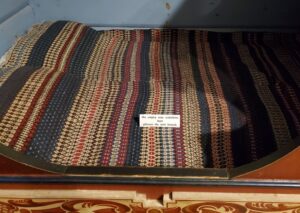
Krokbragd coverlet Vesterheim Museum
Penny Lacroix has been weaving for over 25 years and is a long-time member of the NVWG. She teaches at A Place to Weave and other venues. One of her delights is seeing what her former (and current) students are weaving!
7:00 pm – Social time, browsing the library, snacks and show & tell 7:30 pm – program begins
Nashoba Valley Weavers' GuildPosted on by Penny Lacroix
Come learn about it at our April meeting! Tuesday 4/28/26, at the Congregational Church of Harvard, 5 Still River Rd Presentation starts at 7:30, but please come early!
Michelle Parrish will introduce us to the concept of a fibershed, their history, and details about the Western Mass Fibershed. (Unfortunately, Peggy Hart will not be able to join us.)
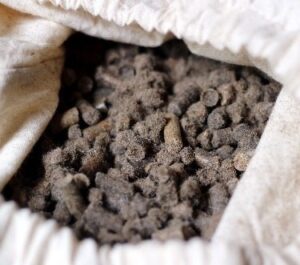
Western Mass Fibershed is a local affiliate of the broader Fibershed movement, working to rebuild regional textile systems and build thriving and sustainable regional fiber economies. Western Mass Fibershed is committed to understanding and strengthening connections and collaboration between farmers, fiber processors and spinning mills, weavers, dyers, and other fiber artists, clothing and shoe designers, retailers, and consumers. As part of Fibershed’s soil to soil philosophy, Western Mass Fibershed utilizes wool from western Massachusetts to create products ranging from soil-enriching waste wool pellets for gardening to blankets and fabric, to yarns for knitting and weaving. We have recently incorporated as a 501c3. For more information please see our website.
Peggy Hart and Michelle Parrish are two of the Western Mass Fibershed organizers and board members. Peggy is a textile designer and weaver who weaves on 1940s vintage Crompton and Knowles dobby looms to create limited edition blankets and throws and custom blankets for farmers using their own wool. Read more about her work on her website. Michelle is an educator with a passion for plants, fibers, and understanding more deeply how we’re all connected on this beautiful planet. You can check out her natural dye and flax projects here.
Schedule for the evening:
7pm – Library browsing, social time, snacks, and show & tell
Nashoba Valley Weavers' GuildPosted on by Penny Lacroix
Tuesday 24 March 2026 in person only at the Congregational Church of Harvard, 5 Still River Rd, Harvard MA Start time is 7pm, with the program beginning at 7:30.
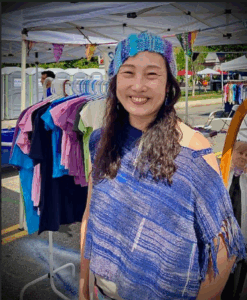
Mihoko Wakabayashi
SAORI Weaving is a contemporary improvisational weaving from Japan. It is based on Zen principle of spontaneity and simplicity. There are no mistakes in SAORI. We embrace any accidental issues such as “Happy Accident”. Mihoko Wakabayashi, a Japan native and an owner of Mihoko Textiles has taught many people of all ages and all abilities in her studio and a variety of organizations and festivals for 25 years. She believes that SAORI weaving is a great way to express inner creativity, connect with others and the world, and build friendships with fellow weavers. She will explain about SAORI weaving and the activities of her studio through a slide show and demonstrate a freestyle weaving on a loom.
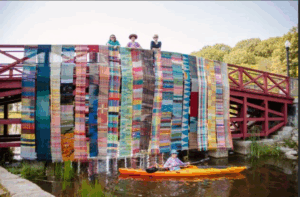
Mihoko Wakabayashi was born and grew up in Japan. Her major in college was education. She learned weaving by working with young people (K-12) who had difficulties in school in Japan and continued learning weaving for seven years. Since she opened her studio “SAORI Worcester” in 2000, she has taught many people including people with various disabilities and become involved in the community. Besides regular classes, she has taught many workshops at different organizations, has conducted one-week fiber camps for children, and has guided a two-week tour in Japan. She made a public art installation SAORI Bridge Project at Elm Park in Worcester in 2021 and developed a program Seed to Fashion to teach weaving with yarn dyed with indigo that people grow together for six years. She continues teaching creative weaving, spinning, dyeing, and sewing through her studio and creates her one-of-a -kind wearable art as Mihoko Textiles.
SAORI Bridge Project at Elm Park in Worcester
People gather for snacks, library browsing, and Show & Tell at 7 pm. Mihoko’s program will start at 7:30. Visitors are welcome!
Nashoba Valley Weavers' GuildPosted on by Penny Lacroix
Barbara Setsu Pickett to talk on Velvet
Tuesday 24 February 2026 on Zoom only Start time is 7pm, with the program beginning at 7:30.
Barbara Setsu Pickett will compress 45 years of research on contemporary velvet weaving practices throughout the world into her Power Point presentation. She’ll begin with her Fulbright Fellowship at the Foundation Lisio and highlight her explorations in 10 countries at ateliers where the 40 masters of velvet weaving work their artistry. She’ll conclude with how a studio artist in the USA can approximate the process using standard looms and equipment.
Barbara Setsu Pickett, an Associate Professor Emerita in the Art Department at the University of Oregon, focuses her art and research on velvetweaving, shibori, book arts, and natural dyeing. She has studied velvetweaving in Italy, France, Spain, England, Japan, China, Turkey, Uzbekistan, and India. Currently she is investigating the Andalus connection between Valencia, Spain and Fez, Morocco. She has received support from the NEA, Fulbright Commission, Institute of Turkish Studies, Gladys Krieble Delmas Foundation, Rockefeller Foundation/Bellagio, and Asian Art Museum in San Francisco. She and her son run Mihara Shibori Studio and create highly textured silk scarves. Her current research trip is supported by two grants, the Dee Brown Memorial Grant and the HGA Mearl K. Gable II Memorial Fund.
A Zoom link will be sent to all current members before the meeting. Visitors should contact us to get the link.
Nashoba Valley Weavers' GuildPosted on by Penny Lacroix
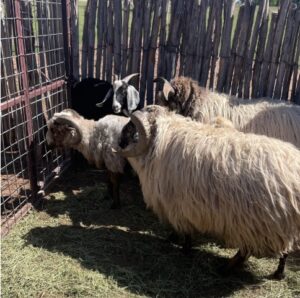
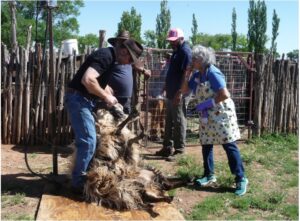
Churro sheep
Our first meeting of 2026 will be on Tuesday 27 January on Zoom only!
Myra Chang Thompson will present
The Connection Between Spanish Colonial Trade and the Role of Churro Sheep
In this presentation Myra will introduce the textile trade during the Spanish Colonial Period (1650 to 1800) which importantly involved the Churro sheep.
Spanish colonists were completely stranded from their mother country, Spain, geographically, economically, socially and, linguistically at various times during the Colonial period. It is then that a realization that their survival greatly depended on how they reacted to their situation. With many of the technologies and skills from the Old World, the colonists adapted to their surroundings and the natural environment in which they were settled. The textile “cottage Industry” played a large part in the colonists’ survival. The Churro sheep consequently were at the center of it all.
Myra was born in Northern New Mexico. Her maternal grandfather raised sheep in New Mexico. She has had a lifelong interest in fiber of all sorts. She was a member of the Stockton, CA Weavers Guild. There she met and learned from E. E. Gilmore, loom builder. Eventually she and her husband, Bill, moved to Massachusetts. She taught special education in various public schools and joined the Weavers Guild of Boston. She loved the changes of seasons but missed the longer summers.
Family events led to a return to New Mexico. Myra has been active in the Fiber 2 Finish Fiber Arts Guild of Valencia County, serving as president for 10 years. She is also a member of Las Arañas Spinners and Weavers Guild in Albuquerque for 20 years and is the current president. She’s been a member of HGA for more than 40 years. She teaches regionally and nationally (Convergence Knoxville and Wichita.). Her guild experiences have given her a unique appreciation for learning, creativity, volunteerism, team building and lifelong friendships. She maintains a studio in her home under the careful eyes of two sister cats and a loving dog. She teaches a variety of classes at Fiber Arts on Fourth in Albuquerque.
A Zoom link will be sent to all NVWG members before the meeting. If you are a visitor and would like to attend, please email programs@nvwg.org.
Nashoba Valley Weavers' GuildPosted on by Penny Lacroix
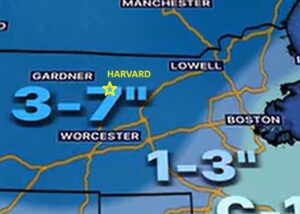
Hopefully we will not have to deal with this on Tuesday, but just in case, here’s what you need to know:
Generally, if the Harvard Public Schools are closed, we do not have a meeting in Harvard. We’ll also send an email to membership. If you’re not a member and are wondering about a meeting, please contact us before venturing out.
Of course, in January and February, our meetings are on Zoom, so they happen regardless of the weather!
Nashoba Valley Weavers' GuildPosted on by Penny Lacroix
Tuesday 2 December, starting at 1 pm (NOTE THIS IS AN AFTERNOON MEETING!)
Location: Congregational Church of Harvard, 5 Still River Rd, Harvard MA
Come weave with found natural materials! Beautiful seedhead from the side of the road? Irresistible piece of driftwood? Intriguing porcupine quills? Here’s the opportunity to play!
Guild member Fran Levi will lead participants in making small woven creations off the loom with items found in nature. She will bring wisteria and grape vine wreaths and straight and forked sticks for making primitive looms and lots of dried flowers, birchbark, feathers, wasp nests, snake skins and more to share. Hemp, linen, wire and other warp options will be available.
Participants might bring collage scissors (not your good fiber scissors!), pruning shears, a tapestry needle, crochet hook, scraps of hand spun, a portable warped loom or a started basket and whatever you’ve found in nature that might be fun to weave.
Fran is a juried member of The League of New Hampshire Craftsmen. She is one of the leaders of the weaving program at the Townsend Senior Center.
Fran is also looking for a few people who can commit to arriving at 12 to help get transfer supplies from her car and set up, and people who can stay afterward to help clean up.
Nashoba Valley Weavers' GuildPosted on by Penny Lacroix
Doubleweave Round Robin; 4 to 8 and more shafts
Thursday 3/19/26 to Saturday 3/21/26 At the Congregational Church in Harvard, MA
Doubleweave coasters woven by Gretchen Romey-Tanzer
Gretchen Romey-Tanzer will be leading this round robin workshop exclusively for members of the NVWG.
The workshop will be an introduction and expansion of double layer doubleweave. We will cover designing and drafting doubleweave structures with color interactions being the focus. Looms will be set-up to sample systems that will produce different effects depending on treadling sequences and weft colors used. Experimentation will be encouraged. A handout of all the potential samples will be included.
The workshop will be limited to 15 people. Cost will be $150 plus materials fee (approximately $20.)
Participants must be able to warp their loom (4-16 shaft table or floor loom) independently prior to the workshop. Warps and drafts will be provided by Gretchen a few weeks prior to the workshop. All level of weavers are welcome.
Signup will begin on 12/1/25. A signup link will be sent to members on that date. (No signups will be accepted before that date.) The tuition must be fully paid within a week of that date in order to hold your spot. Those who are attending the Guild meeting on Tuesday 12/2 may deliver checks or cash at that time. Others may be mailed to NVWG, PO Box 50, Harvard MA 01451.
Gretchen Romey-Tanzer has been a professional weaver, teacher and fiber artist for over 45 years. Her focus on complex doubleweave has received recognition for Excellence in Weaving from the American Craft Council and the Massachusetts Cultural Council. Gretchen’s fiber pieces are in the collections of Art Museum collections in Boston MA, Denver CO, and Racine WI. She has been leading doubleweave workshops to New England weavers for 15 years.